what are three colonies founded to escape religious persecution in europe?
/https://tf-cmsv2-smithsonianmag-media.s3.amazonaws.com/filer/Presence-God-Country-Bible-Riots-631.jpg)
Wading into the controversy surrounding an Islamic center planned for a site near New York City'south Ground Cipher memorial this past August, President Obama declared: "This is America. And our commitment to religious freedom must be unshakeable. The principle that people of all faiths are welcome in this state and that they will not be treated differently by their government is essential to who we are." In doing so, he paid homage to a vision that politicians and preachers take extolled for more two centuries—that America historically has been a place of religious tolerance. It was a sentiment George Washington voiced shortly after taking the adjuration of office just a few blocks from Ground Zero.
But is it then?
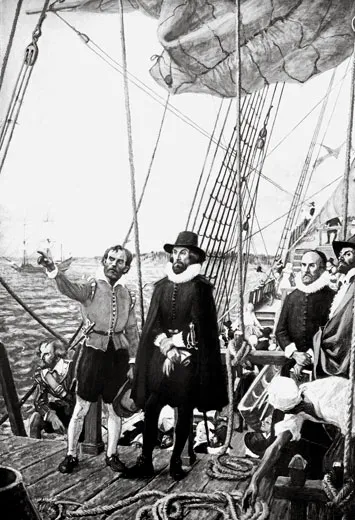
In the storybook version most of united states learned in schoolhouse, the Pilgrims came to America aboard the Mayflower in search of religious freedom in 1620. The Puritans before long followed, for the same reason. Ever since these religious dissidents arrived at their shining "urban center upon a hill," as their governor John Winthrop called information technology, millions from around the earth have done the aforementioned, coming to an America where they found a welcome melting pot in which anybody was gratis to practice his or her own faith.
The problem is that this tidy narrative is an American myth. The real story of organized religion in America's by is an often bad-mannered, frequently embarrassing and occasionally bloody tale that most civics books and high-schoolhouse texts either paper over or shunt to the side. And much of the contempo chat nearly America's ideal of religious freedom has paid lip service to this comforting tableau.
From the primeval inflow of Europeans on America'southward shores, faith has often been a cudgel, used to discriminate, suppress and even kill the strange, the "heretic" and the "unbeliever"—including the "pagan" natives already here. Moreover, while it is true that the vast majority of early on-generation Americans were Christian, the pitched battles between diverse Protestant sects and, more than explosively, between Protestants and Catholics, present an unavoidable contradiction to the widely held notion that America is a "Christian nation."
First, a little overlooked history: the initial run into between Europeans in the future United States came with the institution of a Huguenot (French Protestant) colony in 1564 at Fort Caroline (near mod Jacksonville, Florida). More than than half a century earlier the Mayflower set sail, French pilgrims had come to America in search of religious freedom.
The Spanish had other ideas. In 1565, they established a forward operating base at St. Augustine and proceeded to wipe out the Fort Caroline colony. The Spanish commander, Pedro Menéndez de Avilés, wrote to the Castilian King Philip 2 that he had "hanged all those we had found in [Fort Caroline] because...they were scattering the odious Lutheran doctrine in these Provinces." When hundreds of survivors of a shipwrecked French fleet washed up on the beaches of Florida, they were put to the sword, beside a river the Spanish called Matanzas ("slaughters"). In other words, the first encounter between European Christians in America ended in a blood bath.
The much-ballyhooed arrival of the Pilgrims and Puritans in New England in the early on 1600s was indeed a response to persecution that these religious dissenters had experienced in England. But the Puritan fathers of the Massachusetts Bay Colony did not eyebrow tolerance of opposing religious views. Their "city upon a colina" was a theocracy that brooked no dissent, religious or political.
The nearly famous dissidents within the Puritan community, Roger Williams and Anne Hutchinson, were banished post-obit disagreements over theology and policy. From Puritan Boston's earliest days, Catholics ("Papists") were anathema and were banned from the colonies, along with other not-Puritans. Iv Quakers were hanged in Boston between 1659 and 1661 for persistently returning to the city to stand up for their beliefs.
Throughout the colonial era, Anglo-American antipathy toward Catholics—peculiarly French and Spanish Catholics—was pronounced and oftentimes reflected in the sermons of such famous clerics as Cotton fiber Mather and in statutes that discriminated against Catholics in matters of property and voting. Anti-Catholic feelings even contributed to the revolutionary mood in America subsequently King George III extended an olive branch to French Catholics in Canada with the Quebec Act of 1774, which recognized their organized religion.
When George Washington dispatched Benedict Arnold on a mission to court French Canadians' support for the American Revolution in 1775, he cautioned Arnold not to allow their religion get in the style. "Prudence, policy and a truthful Christian Spirit," Washington advised, "will atomic number 82 united states to look with compassion upon their errors, without insulting them." (Afterwards Arnold betrayed the American cause, he publicly cited America's alliance with Catholic France as one of his reasons for doing so.)
In newly contained America, there was a crazy quilt of country laws regarding religion. In Massachusetts, only Christians were allowed to hold public part, and Catholics were allowed to do and then simply after renouncing papal authority. In 1777, New York State'due south constitution banned Catholics from public office (and would do then until 1806). In Maryland, Catholics had total civil rights, but Jews did not. Delaware required an adjuration affirming belief in the Trinity. Several states, including Massachusetts and South Carolina, had official, country-supported churches.
In 1779, as Virginia's governor, Thomas Jefferson had drafted a bill that guaranteed legal equality for citizens of all religions—including those of no religion—in the country. It was effectually then that Jefferson famously wrote, "But it does me no injury for my neighbor to say there are twenty gods or no God. Information technology neither picks my pocket nor breaks my leg." But Jefferson's plan did not advance—until later Patrick ("Give Me Liberty or Give Me Expiry") Henry introduced a nib in 1784 calling for state back up for "teachers of the Christian organized religion."
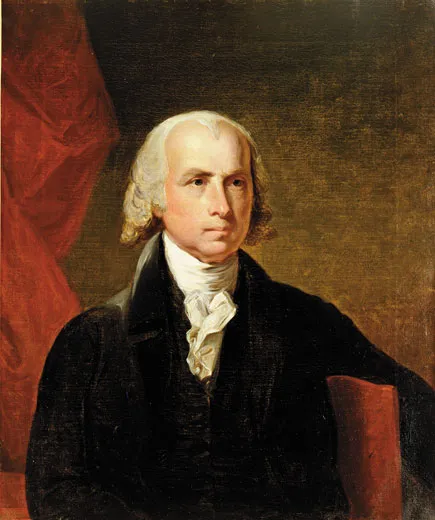
Future President James Madison stepped into the breach. In a carefully argued essay titled "Memorial and Remonstrance Against Religious Assessments," the before longhoped-for father of the Constitution eloquently laid out reasons why the state had no business supporting Christian didactics. Signed by some 2,000 Virginians, Madison'due south argument became a fundamental piece of American political philosophy, a ringing endorsement of the secular state that "should be as familiar to students of American history every bit the Declaration of Independence and the Constitution," as Susan Jacoby has written in Freethinkers, her excellent history of American secularism.
Among Madison'due south fifteen points was his declaration that "the Faith then of every human being must be left to the conviction and conscience of every...man to do it every bit these may dictate. This right is in its nature an inalienable right."
Madison also fabricated a point that any believer of any organized religion should understand: that the government sanction of a religion was, in essence, a threat to organized religion. "Who does non encounter," he wrote, "that the aforementioned potency which can establish Christianity, in exclusion of all other Religions, may establish with the same ease any particular sect of Christians, in exclusion of all other Sects?" Madison was writing from his memory of Baptist ministers being arrested in his native Virginia.
Equally a Christian, Madison also noted that Christianity had spread in the confront of persecution from worldly powers, not with their help. Christianity, he contended, "disavows a dependence on the powers of this world...for information technology is known that this Religion both existed and flourished, non only without the support of man laws, but in spite of every opposition from them."
Recognizing the thought of America every bit a refuge for the protester or insubordinate, Madison also argued that Henry's proposal was "a departure from that generous policy, which offering an Asylum to the persecuted and oppressed of every Nation and Organized religion, promised a lustre to our country."
After long debate, Patrick Henry'southward beak was defeated, with the opposition outnumbering supporters 12 to 1. Instead, the Virginia legislature took up Jefferson's plan for the separation of church building and state. In 1786, the Virginia Act for Establishing Religious Freedom, modified somewhat from Jefferson's original draft, became constabulary. The act is 1 of iii accomplishments Jefferson included on his tombstone, along with writing the Declaration and founding the University of Virginia. (He omitted his presidency of the U.s..) After the bill was passed, Jefferson proudly wrote that the constabulary "meant to comprehend, inside the mantle of its protection, the Jew, the Gentile, the Christian and the Mahometan, the Hindoo and Infidel of every denomination."
Madison wanted Jefferson'due south view to become the constabulary of the country when he went to the Ramble Convention in Philadelphia in 1787. And every bit framed in Philadelphia that yr, the U.S. Constitution conspicuously stated in Article VI that federal elective and appointed officials "shall be jump by Oath or Affidavit, to support this Constitution, but no religious Test shall always exist required equally a Qualification to whatever Office or public Trust under the Us."
This passage—along with the facts that the Constitution does not mention God or a deity (except for a pro forma "year of our Lord" appointment) and that its very start amendment forbids Congress from making laws that would infringe of the costless exercise of religion—attests to the founders' resolve that America exist a secular republic. The men who fought the Revolution may take thanked Providence and attended church building regularly—or not. Only they also fought a state of war against a land in which the head of state was the caput of the church. Knowing well the history of religious warfare that led to America's settlement, they conspicuously understood both the dangers of that organisation and of sectarian conflict.
It was the recognition of that divisive past by the founders—notably Washington, Jefferson, Adams and Madison—that secured America every bit a secular republic. As president, Washington wrote in 1790: "All possess alike freedom of conscience and amnesty of citizenship. ...For happily the Government of the Us, which gives to bigotry no sanction, to persecution no assistance requires merely that they who live under its protection should demean themselves as good citizens."
He was addressing the members of America's oldest synagogue, the Touro Synagogue in Newport, Rhode Island (where his letter is read aloud every Baronial). In closing, he wrote specifically to the Jews a phrase that applies to Muslims every bit well: "May the children of the Stock of Abraham, who dwell in this state, continue to merit and savour the good will of the other inhabitants, while every one shall sit in safety under his own vine and figtree, and there shall be none to brand him afraid."
As for Adams and Jefferson, they would disagree vehemently over policy, just on the question of religious liberty they were united. "In their seventies," Jacoby writes, "with a friendship that had survived serious political conflicts, Adams and Jefferson could await back with satisfaction on what they both considered their greatest achievement—their role in establishing a secular government whose legislators would never be required, or permitted, to dominion on the legality of theological views."
Late in his life, James Madison wrote a letter of the alphabet summarizing his views: "And I have no doubt that every new example, will succeed, every bit every past one has done, in shewing that organized religion & Govt. will both be in greater purity, the less they are mixed together."
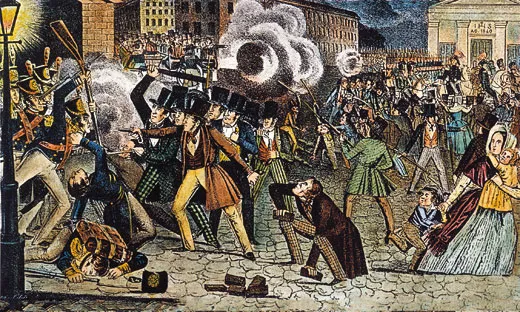
While some of America's early leaders were models of virtuous tolerance, American attitudes were irksome to alter. The anti-Catholicism of America's Calvinist past plant new voice in the 19th century. The belief widely held and preached by some of the most prominent ministers in America was that Catholics would, if permitted, turn America over to the pope. Anti-Catholic venom was part of the typical American school day, along with Bible readings. In Massachusetts, a convent—coincidentally near the site of the Bunker Hill Monument—was burned to the basis in 1834 by an anti-Catholic mob incited by reports that young women were being abused in the convent school. In Philadelphia, the City of Brotherly Love, anti-Cosmic sentiment, combined with the country's anti-immigrant mood, fueled the Bible Riots of 1844, in which houses were torched, ii Catholic churches were destroyed and at least 20 people were killed.
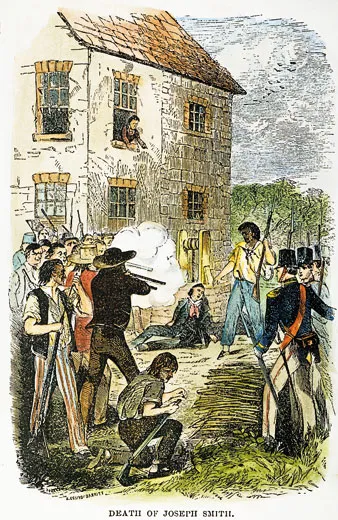
At most the same time, Joseph Smith founded a new American religion—and before long met with the wrath of the mainstream Protestant bulk. In 1832, a mob tarred and feathered him, marking the beginning of a long boxing between Christian America and Smith's Mormonism. In October 1838, after a serial of conflicts over state and religious tension, Missouri Governor Lilburn Boggs ordered that all Mormons be expelled from his land. Three days later, rogue militiamen massacred 17 church building members, including children, at the Mormon settlement of Haun'southward Factory. In 1844, a mob murdered Joseph Smith and his brother Hyrum while they were jailed in Carthage, Illinois. No one was e'er convicted of the criminal offense.
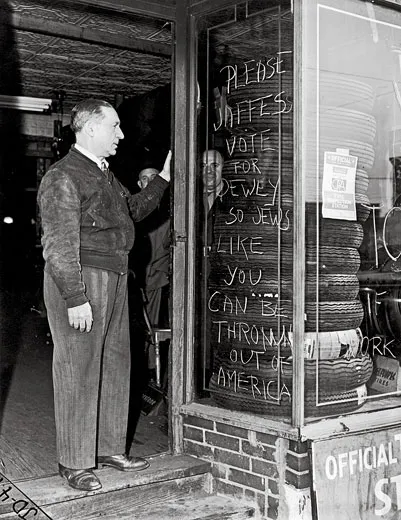
Fifty-fifty equally late as 1960, Catholic presidential candidate John F. Kennedy felt compelled to make a major speech declaring that his loyalty was to America, not the pope. (And as recently equally the 2008 Republican main campaign, Mormon candidate Mitt Romney felt compelled to address the suspicions notwithstanding directed toward the Church of Jesus Christ of Latter-twenty-four hours Saints.) Of course, America'south anti-Semitism was practiced institutionally also as socially for decades. With the cracking threat of "godless" Communism looming in the 1950s, the state'south fear of disbelief also reached new heights.
America can still be, equally Madison perceived the nation in 1785, "an Asylum to the persecuted and oppressed of every Nation and Religion." But recognizing that deep religious discord has been function of America'south social DNA is a healthy and necessary pace. When we acknowledge that dark by, perhaps the nation will return to that "promised...lustre" of which Madison so grandiloquently wrote.
Kenneth C. Davis is the writer of Don't Know Much Well-nigh History and A Nation Ascension, among other books.
Source: https://www.smithsonianmag.com/history/americas-true-history-of-religious-tolerance-61312684/
0 Response to "what are three colonies founded to escape religious persecution in europe?"
Post a Comment